One of the most common specifications for comparing spectrum analyzers is sweep speed. It is important to understand exactly what resolution is being considered when specifying sweep speed. To start the discussion, let’s look at the OSCOR Spectrum Analyzers which sweep from 10 kHz to 24 GHz in 1 second. Therefore, the sweep speed is 24 GHz/sec with a frequency resolution of 12.2 KHz. This means that every second, it produces a trace of 24 GHz span with 2,000,000 data points. Consequently, if you are using an OSCOR and only sweeping 8 GHz, then the sweep speed is 24 GHz/sec, but now the unit covers the 8 GHz span 3 times in one second.
REI is pleased to announce a training partnership with Eavesdropping Detection Solutions (EDS) to present technical surveillance countermeasure (TSCM) training courses on a regular basis in South Africa. The strategic partnership between REI and EDS means that many TSCM practitioners from outside of the USA who cannot afford to travel to the United States, or for whom it is inconvenient, will be able to receive the same high level training and certification in South Africa.
REI General Manager, Tom Jones, recently met with Tennessee Senators Lamar Alexander and Bob Corker in Washington DC, along with Stacie Oliver, Senior Professional Staff Member, Senate Committee on Foreign Relations, to discuss export control reform. The meeting also provided Jones an opportunity to express his appreciation for their help on behalf of REI.
FOR IMMEDIATE RELEASE:
Research Electronics International (REI) is pleased to announce the ANDRE™ Advanced Near-field Detection Receiver, a hand-held broadband receiver that detects and assists in locating nearby RF, infrared, visible light, carrier current and other types of transmitters.
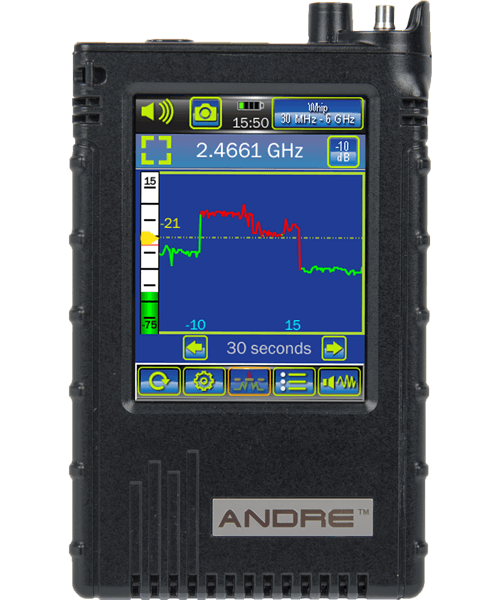 The ANDRE detects signal activity in its vicinity and displays changes in signal strength over time, allowing users to quickly locate the source of transmissions. The ANDREs frequency counter provides quick identification of the signal frequency and outputs additional information to an automatic signal list generator.
Antenna probes included with the ANDRE can be used to sweep rooms and objects in search for known, unknown, illegal, disruptive, or interfering transmitters from 10 kHz to 6 GHz.
A 3.5 inch touch screen displays all of the operation controls and frequency activity. The frequency chart provides advantages over other RF detectors by showing rising and falling signal strength over time. Eight displayed time intervals can be selected ranging from 5 seconds to 24 hours. This helps identify pulsing signals and shows historical peaks, to ensure nothing will be missed. Manual and automatic threshold settings notify the user when a signal exceeds defined strength levels with haptic, audible, and visual alerts.
Continue reading “New Hand-held ANDRE Quickly Detects Transmitters”
REI has recently opened registration for five upcoming Business Intelligence Protection Seminars (BIPS). REI’s free, one-day seminars are designed to familiarize security professionals with the dangers of information loss through illicit electronic surveillance.
“It’s important for businesses to remember the vulnerabilities in their own offices, buildings, and meeting spaces,” says Mark Uker, REI Training Director. “This goes beyond the theft of intellectual property – even the wrongful exposure of personal conversations between employees can have devastating effects on a company.” Continue reading “REI Announces Spring Business Intelligence Protection Seminars”
On September 10, REI was presented with the Glenn H. Whidden Award for Best New Equipment at the 2016 Espionage Research Institute International (ERII) conference in Alexandria, Virginia. The award was presented for the Advanced Near-field Detection Receiver (ANDRE).
Continue reading “REI Receives Glenn H. Whidden Award for Best New Equipment”
REI announces that, following a commodity jurisdiction determination issued by the U.S. Department of State – Directorate of Defense Trade Controls (“DDTC”), the REI OSCOR Blue spectrum analyzer (8 GHz and 24 GHz models) is no longer subject to International Traffic in Arms Regulation (“ITAR”) jurisdiction. Effective immediately, the OSCOR Blue is subject to the Export Administration Regulations (“EAR”) administered by the Department of Commerce – Bureau of Industry and Security (“BIS”) and has been assigned to Export Control Classification Number (“ECCN”) 3A992.A. The OSCOR Blue now has the same export control status as the OSCOR Green spectrum analyzer.
Continue reading “OSCOR™ Blue Spectrum Analyzer Reclassified From ITAR”
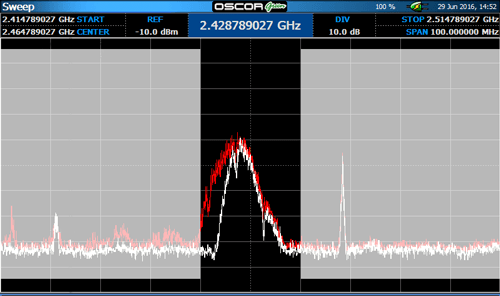
When comparing spectrum analyzers, it has become common to reference a 100% Probability of Intercept (POI) specification. POI refers to the minimum transmitter pulse duration that can be detected with a 100% Probability of Intercept. When looking at these types of specifications, it is very important to understand the assumptions behind the claims and how they are calculated; with POI, it is essential to understand the span at which the POI spec is calculated.
 To assist with report writing and analysis after a sweep is complete, the OSCOR provides the ability to capture various types of information from the display, demodulated video, and audio signals. All information captured is stored to either a compact flash card or a USB storage device, not the OSCOR itself. In order to recognize an external USB hard drive, the device must be formatted with a FAT file system such as FAT32. If needed, the OSCOR can format the hard drive using the Storage Manager feature (see page 22 of the OSCOR Green manual).
Broadband detectors like the REI CPM-700 can be used to physically sweep a room to locate the source of a radio frequency (RF) transmission. One of the benefits of a broadband detector is the displayed response to a nearby transmitter is almost instantaneous. When the antenna comes within range of a transmitter, an immediate response is displayed if it is the strongest signal present.
Continue reading “Using Broadband Detectors to Find Transmitters”